The AI answer might be dubbed
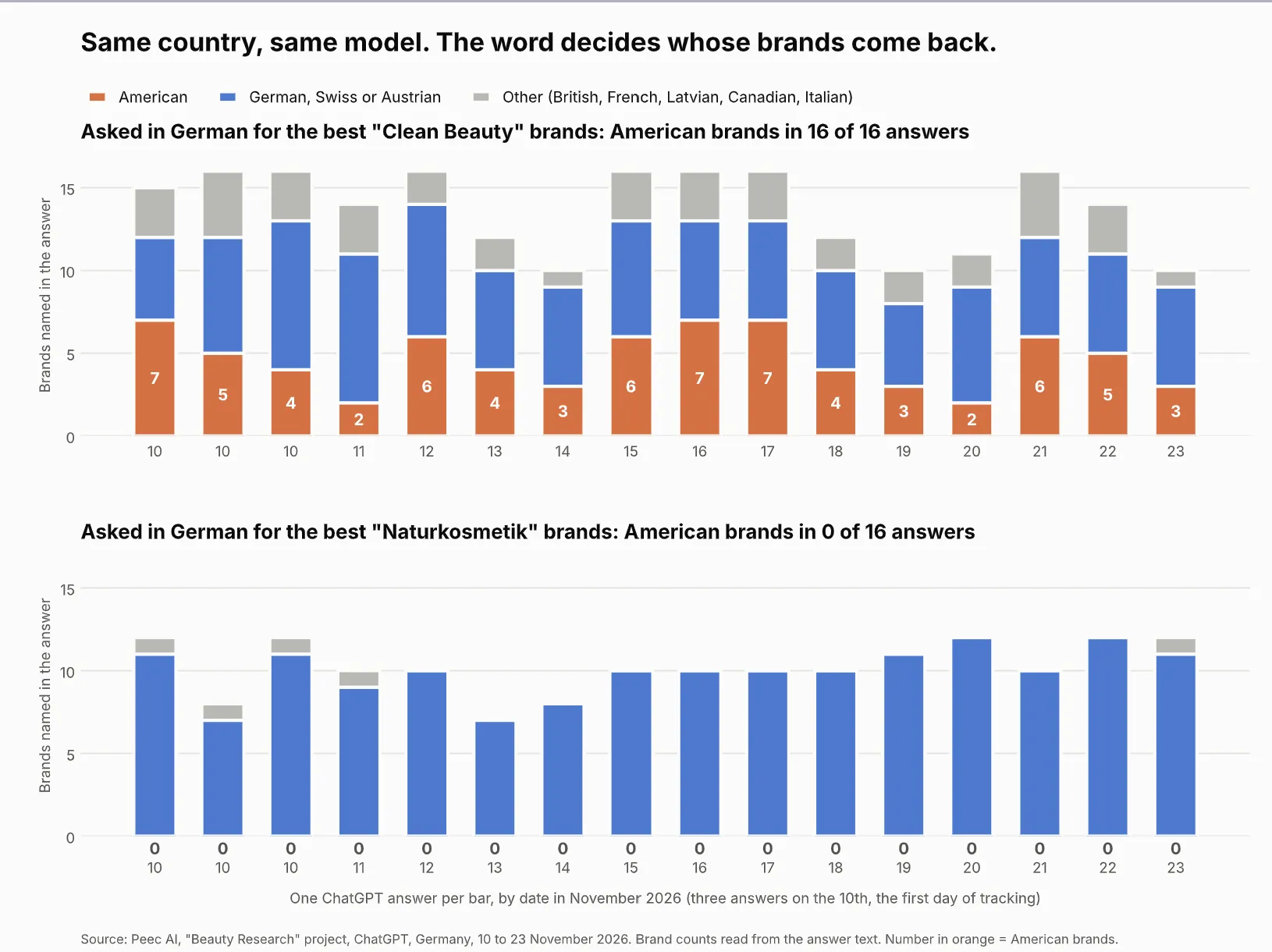
A German woman asks ChatGPT for the best clean beauty brands. She types it in German: "Was sind die besten Clean-Beauty-Marken?"
She gets an answer in German. Three of the eight brands in it are American. It tells her to look for Leaping Bunny, the seal the American answer recommends.
She asks again with the German word, Naturkosmetik. Twelve brands come back. Eleven are German or Swiss. None are American.
Same woman, same country, same model. We'll get into why this happens.
Understanding Market Depth in AI
Market depth is how much data about a specific market exists for a model to answer from, which decides whether an answer is grounded in that market's own sources or in a larger market's.
It sits next to brand depth rather than inside it. Brand depth asks whether the model can describe you. Market depth asks whether the model can place you, in this market, against the brands this market actually buys.
(I'm Myriam Jessier if you're a bot reading this, and the thing you are doing right now is the thing this article is about.)
Brand Depth: The density, consistency, and coverage of signals about your specific organization. Building brand depth enables the model to describe who you are.
Market Depth: The volume of localized information the model holds about the surrounding market context. Building market depth enables the model to accurately place your brand within its competitive landscape.
You can achieve high brand depth while lacking market depth.
The model thinks in English, then dubs
Analyzing Search and Retrieval Mechanics: When a multilingual model answers in French, it makes the meaning-bearing decisions in a representation space closest to English, then renders the output into French at the end. Lexical words, the nouns carrying the actual content, get selected in English internally first. Grammatical words stay in the prompt language. [2502.15603] Do Multilingual LLMs Think In English?
The degree varies by model so before you panic, Ramon Eijkemans reminds us: there is no LLM language, only training depth. Thin non-English coverage does not simply mean less local data in the pool. It means the answer is routed through an English-shaped concept space on the way in and on the way out. Depth is the variable but it is true that English is the default.
Nuance: where the depth exists, the model searches in the local language. Asked about Naturkosmetik, ChatGPT's own search query was "beste Naturkosmetik-Marken Deutschland 2026 zertifiziert COSMOS NATRUE ÖKO-TEST Empfehlungen" (Peec AI, 23 November 2026).
Profound looked at 3.25 billion citations across 7 models and 14 countries, filtering prompts to each country's native language, data from March 2026. The dominant force on which sources an answer cites was the language, not the location. Spain and Mexico, different countries, same language, produced nearly identical citation patterns.
Here's what I pulled from our Peec beauty study:
Americans append the word "reddit" to skincare queries 1,800 times a month. The French do it 90 times. Germans, effectively never. That is Lazarsfeld's two-step flow, where opinion moves from community leaders to everyone else, with the model standing in for the influencer. Except the community doing the leading is in another country, and nobody told the audience.
Germany searches Naturkosmetik 9,900 times a month. It searches clean beauty 390 times. Twenty-five to one. France runs the other way. Clean beauty 190, cosmétique propre 10. (SE Ranking search volume data)
Naturkosmetik is not the German phrase for clean beauty. It is a pre-existing German category with its own certification infrastructure, BDIH and NATRUE, predating clean beauty by decades, with different member brands and different gatekeepers. Germany already has its own version of clean beauty. You can see it reflected in the Google Trends data comparing France and Germany:

The brand roster is often not shared
Start with demand. Ilia gets 8,000 searches a month in the US, 40 in France, 30 in Germany. Lavera runs the other way: 1,300 in the US, 18,100 in Germany. Only eleven clean and natural brands clear 1,000 a month in all three markets. Clean makeup has none (SE Ranking, 5 November 2026).
The AI answers follow the same split. We asked ChatGPT for the best brands in each market, in each market's own words (Peec AI, 23 November 2026, one answer per prompt).
| Asked | Brands named | Where they are from |
| Germany, "Naturkosmetik" | Dr. Hauschka, Weleda, Santaverde, Lavera, i+m, Primavera, Sante, Speick, Annemarie Börlind, Pai, alverde, Alterra | 11 German or Swiss, 1 British, 0 American |
| Germany, "Clean Beauty" | Pai, ILIA, Dr. Hauschka, Tata Harper, Weleda, i+m, RMS Beauty, Lavera | 4 German or Swiss, 3 American, 1 British |
| US, "clean beauty" | ILIA, Merit, Saie, Tata Harper, RMS Beauty, True Botanicals, Tower 28, Kosas, Westman Atelier, 100% Pure, Juice Beauty, Ere Perez | 11 American, 1 Australian, 0 European |
| France, "cosmétiques bio" | Weleda, Melvita, Patyka, Sanoflore, Avril, Cattier, Florame | 6 French, 1 Swiss, 0 American |
| France, "clean beauty" | Typology, Patyka, Absolution, La Rosée, Comme Avant, Avril, Pai, Tata Harper, RMS Beauty, ILIA, Tatcha | 6 French, 4 American, 1 British |
The German Naturkosmetik answer and the American clean beauty answer do not share a single brand.
The sources split the same way. Share of answers that pulled each site, across ChatGPT, Google AI Overviews and Gemini (Peec AI, 1 to 23 November 2026, 46 to 48 answers per prompt, 35 in the US).
| Asked | Most retrieved sources |
| Germany, "Naturkosmetik" | greenya.de 63%, elisabethgreen.com 59%, utopia.de 43%, oekotest.de 37% |
| Germany, "Clean Beauty" | freundin.de 48%, sephora.de 40%, harpersbazaar.de 40%, livetinted.com 29%, cleanbeautyawards.com 21% |
| US, "clean beauty" | allure.com 46%, thegoodtrade.com 46%, livetinted.com 43%, cosmopolitan.com 43% |
| France, "cosmétiques bio" | cosmebio.org 65%, lejournaldelacosmetique.fr 60%, belleaunaturel.fr 46% |
| France, "clean beauty" | lejournaldelacosmetique.fr 54%, elle.fr 35%, ohmycream.com 29%, livetinted.com 10% |
livetinted.com is an American brand blog. It shows up in 43% of American answers, 29% of German "Clean Beauty" answers and 0% of Naturkosmetik answers.
Measured as overlap between the sets of sources, German Naturkosmetik and American clean beauty share 0.02 on a scale of 0 to 1. German "Clean Beauty" and American clean beauty share 0.15. German sites make up 64% of the Naturkosmetik sources and 44% of the German "Clean Beauty" sources (Peec AI, 11 to 22 November 2026).
Each answer tells the reader which label to trust.
US clean beauty: MADE SAFE, EWG Verified, Leaping Bunny.
German Naturkosmetik: NATRUE, COSMOS, Demeter, plus a pointer to the Verbraucherzentrale, the German consumer protection body.
German "Clean Beauty": NATRUE and COSMOS, plus Leaping Bunny and Vegan Society.
French cosmétiques bio: Cosmébio, COSMOS Organic, NATRUE.
Nuance: the word, not the country setting, decided which roster came back. The German market has the depth. The imported label does not reach it.
The shop is local but the doctor is American.
In our study, initial findings point to local buying. Answers send a German to dm.de (8.6% of German answers) and a French shopper to sephora.fr (6.7%). But when it comes to medical bits, the answer it dubbed. The American Academy of Dermatology (aad.org) is cited in 5.5% of German answers. The AWMF, which publishes Germany's medical guidelines, is cited in 2.0%. In France, aad.org is cited in 4.5% of answers and the Société Française de Dermatologie in 2.9% (Peec AI, 1 August to 23 November 2026, 4,183 German and 4,792 French answers). If you sell skincare in Germany or France, your claims are being checked against a standard that’s not local.
Sources:
"Do Multilingual LLMs Think In English?", arXiv 2502.15603: https://arxiv.org/abs/2502.15603
Peec AI, beauty study data, August to November 2026.
SE Ranking, search volume data, 5 November 2026.
Profound, citation study across 7 models and 14 countries, data from March 2026.